Smart Tag: Tracker Panorama from brand native to third-party certification: A Guide to Typology, technical characteristics, and ecological adaptation and selection
I. Core Definition: Smart Tag is a catch-all for trackers
Smart Tag is an umbrella term for any small device that uses near-field technologies such as Bluetooth and UWB to locate and track objects. It falls into three categories:
The original brand: the exclusive models launched by the tech giants, such as Apple’s AirTag, Samsung’s Galaxy Smart tag, Huawei’s Tag and so on, rely on their own ecosystem to achieve functions;
Third-party certification: Official brand certification (such as Apple MFI certification, Samsung Accessory certification) compatible devices, by professional factories (such as China Minew, the United States Belkin) production, access to the brand’s native tracking network
Universal compatible: made by global electronics factories (mainly in China and Southeast Asia) , no need to be tied to a specific brand, multi-os (iOS/Android) positioning via separate apps, SmartTag“Flex”.
Simply put, an AirTag is a specific model within a Smart Tag (Apple’s branded, Unbranded Model) , which is a catch-all term for any tracking device from a brand’s flagship to a third-party, affordable product.
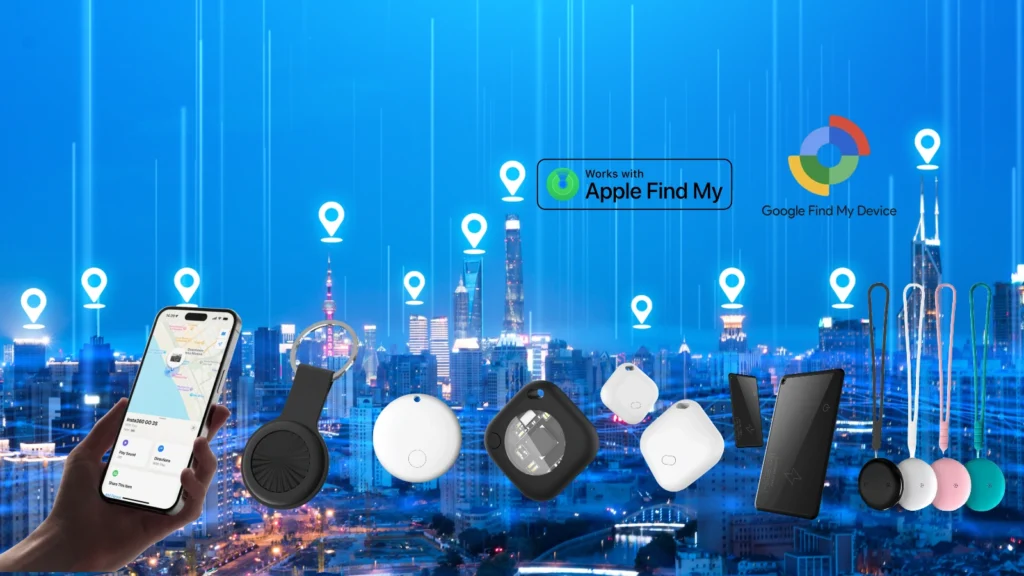
Category Breakdown: Technology and design differences among the three smart tags
1. Original brand: the flagship of deep ecological binding
Typical of Apple airtags and Samsung Galaxy Smarttag2s, the core feature of these smart tags is“Deep synergy between hardware and ecosystem”:

Apple AirTag: uses a disc design (31.9 mm × 8 mm, 11G) , a stainless steel chassis and plastic cover, relies on an Apple U1 chip for UWB positioning (within ≤0.3 m) , and is only compatible with iPhone 11s and above, direct access to the“Find My” ecosystem-a global crowdsourced network of 1 billion + Apple devices that shortens location update intervals to 2-3 minutes (in urban environments) . 1-year battery life (CR2032) , waterproof IP67, keychain fit with extra accessories.
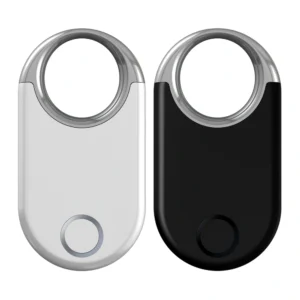
Samsung Galaxy Smarttag2: pill-shaped design (52.44 mm × 28.8 mm × 8 mm, 13.75 g) , matte plastic body + built-in metal hanging ring, equipped with Samsung UWB chip, Galaxy S21 and above models to support AR real-time navigation (error ≤0.5 m) , connect to the“SmartThings Find” network. Battery life 500-700 days (depending on mode) , waterproof IP67, hardware buttons can be linked Samsung smart home.
2. Third-party certification fees: A cost-effective option for the compliance access ecosystem
Produced by a professional factory, through the official certification of the brand to access the corresponding ecological, such as:
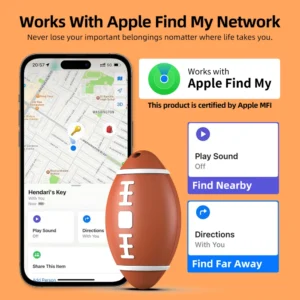
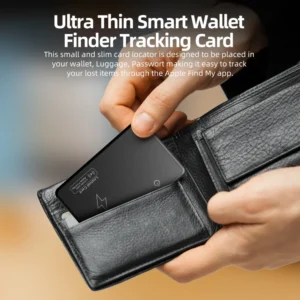
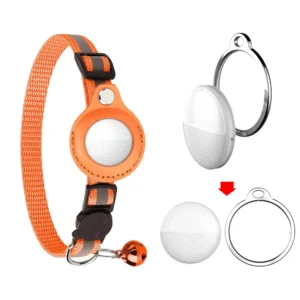
MFI certified (apple Find My) : “FindMate Tag” made at the Minew factory in Shenzhen, China. It looks like an AIRTAG (32mm x 8mm) , uses an apple-approved security chip, and supports Bluetooth 5.1(0.5.1 m) positioning, no UWB, 8-12 month battery life, 60% of the price of an AirTag ($18) , manageable directly from the iPhone’s“Find” APP, and a highly AirTag-like experience.
Samsung certified“Galaxy Tag +” made at the MCNEX factory in South Korea, compatible with Samsung Smart Things ecology, supports AR navigation (error ≤1 meter) , lasts 6 months, and costs 30% less than the original Samsung model, for Galaxy owners looking for value for money.
The core value of these smart tags is“Eco-branding at a lower cost,” with slightly inferior hardware specifications but consistent basic positioning.
3. Universal compatibles: the“Flexible side” of cross-system adaptation
Led by factories in China and Southeast Asia, not dependent on a specific brand ecosystem, multi-system positioning through individual apps, e.g:

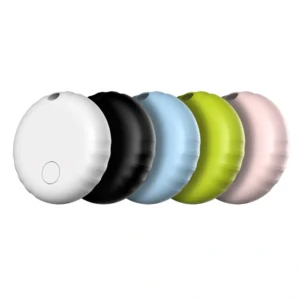
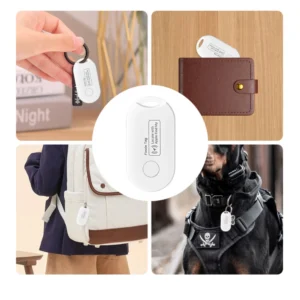
Dual-system base model: “UNITAG” made in Dongguan, China. Bluetooth 5.1 location (3-5 meters) . 6-8 months battery life. $15, users can view the location across devices by logging into the same account, which is suitable for people who frequently switch mobile phone systems.
High-end general-purpose model: Singapore Parya factory“ProTag”, equipped with UWB chip (to be separately licensed) , positioning error of 1-2 meters, battery life of 12 months, the APP, which includes fences, location history (some of which you have to pay to unlock) , costs $25 and is compatible with more than 95% of smartphone models.
The advantage of the generic model is that there are“No ecological barriers”, but location accuracy and network coverage depend on the number of APP users-if the APP has a high number of downloads (e.g. a particular APP has been downloaded more than 10 million times) , 10-15 minute location updates in cities.
Technology at its core: commonalities and differences across all smarttags
Commonality: the underlying logic of near-field positioning
Whether native or third-party, the core principle of Smart Tag is the same: 10-120 meters of near-field communication via Bluetooth 5.0/5.1, when the device is out of range of the user’s phone, the location data is then encrypted and uploaded to the cloud, where it is anonymously“Scanned” by other nearby devices that have installed their equivalent eco-APP (or generic APP) and eventually synced to the owner.
Differences: three keys to an experience
Positioning accuracy: brand original section (such as AirTag) because equipped with UWB chip, accuracy up to 0.3-0.5 m; General-purpose models are 3-5 meters (basic) or 1-2 meters (high-end) .
Network coverage: Native models rely on the number of devices they own (Apple + 1 billion > Samsung + 500 million) ; third-party certifications share the same brand network coverage as native models; generic models rely on the number of users of dedicated apps, the smaller the base, the weaker the coverage.
Eco-linkage: the original brand can be deeply linked with its own services (such as AirTag trigger iPhone Bell, Samsung Tag Control Smart Home) ; Third-party certification only supports basic positioning, no extension features; General-purpose models rely on APP developers, and some support with smart speakers, watches, and (device-compatible) .
Iv. Ecological adaptation: the core basis for Smart tag selection
Apple ecosystem users (iPhone/iPad)
For the ultimate experience: choose Apple AirTag, UWB Precision Point + Find My network coverage, suitable for precision Find keys, headphones and other small pieces.
Limited budget: choose MFI authentication (such as FindMate Tag) , $18 can be connected to Find My network, slightly less accurate but functional enough.

Samsung ecosystem users (Galaxy phones/tablets)
Priority Samsung Smarttag 2,700-day battery life + built-in ring + smart home linkage, suitable for family scenarios.
Cost-effective: Samsung-certified models (like Galaxy Tag +) , 30% cheaper, with consistent basic positioning.
Cross-system or non-flagship users
Basic anti-loss requirements: choose a generic basic model (such as UNITAG) , $15 to achieve dual-system positioning, suitable for wallets, backpacks and other large items.
Medium to high precision: choose a general purpose high-end model (such as ProTag) , $25 with UWB features, balance precision and flexibility.
V. Market Structure: coordination and competition between brands and factories
Brands dominate the high end of the market: Apple AirTag and Samsung SmartTag 2 have 45% of the global SmartTag market and rely on ecological barriers to attract loyal users at $29-$35 a pop.
Third-party certifications dominate the middle: MFi-certified and samsung-certified models made in China have a 30% market share, cost between US $15 and US $25, and focus on“Eco-experience replacement”.
Generics cover the sinking market: generics from factories in China and Southeast Asia, which account for 25% of sales at $10-$15, are sold in Southeast Asia, South and other regions with a mix of brands.
It is worth noting that Chinese factories are at the heart of the Smart Tag chain: 70% of the world’s third-party-certified and 85% of the world’s generic versions are made in China, forming a complete supply chain from chip packaging to finished product assembly, this supports the diversity of the market.
Buying Guide: a decision formula for matching by scenario
Scenario → Accuracy Requirement → type selection:
Find small items (keys, headphones) : branded original (AirTag/SmartTag2) or high-end certified (UWB) ;
Large anti-lost (backpacks, suitcases) : Third-party certification of the basic or general model (accuracy of 3-5 meters enough) ;
Cross-system/multi-device: generic (synced via APP across platforms) .
Budget → Value for money:
< $20: general basis or third-party certification basis
$20-$30: Third-party certified premium or generic premium
> $30: branded original (AirTag/SmartTag2) .
Future Trends: the evolution of Smart Tag technology
Power consumption breakthrough: the“Solar assisted battery life” technology developed by the Chinese factory is expected to be applied to the general-purpose model in 2025, and the battery life will be extended to 18-24 months;
Positioning upgrade: the original brand will integrate satellite communications (such as Apple’s planned 2026 launch of AirTag 2, which will support low-earth orbit satellites) , enabling no-signal area tracking;
Eco-integration: third-party factories are pushing for“Cross-brand agreements,” and future generic models may be able to connect to both Apple Find My and Android Find devices networks, breaking down ecological barriers once and for all.
Conclusion: the essence of Smart Tag is“Fit for purpose”
From Apple airtags to $15 generic models in Chinese factories, the value of smart tags has never been determined by“Brand,” but by matching user scenarios — paying a premium for an ecologically closed loop, choosing a generic model for a flexible fit ultimately points to the same goal: making“Losing” a non-anxiety-inducing chore. The diversity of smart tags, as trackers are known, is testament to their ubiquity: no matter what phone you use or what object you’re chasing, there’s always a Smart Tag waiting in the wings.